2010/04/27

Statistics

I recently read an article about statistics.  It was pretty eye-opening for me, because it really showed me 1) how illiterate we are in basic statistics, and 2) how easy it is to fool someone with important sounding facts.

Part of the problem about statistics, I think, is that they seem so readily accessible to the average person, but how tricky and counter-intuitive they actually can be.

One of the examples from the article was the OJ Simpson trial.  The prosecution went to great lengths to show that OJ was a wife-abuser.  The defense conceded the point, but said "Look, only 1 in 2500 men who beat their wives actually end up killing them."  I could easily see myself sitting on the jury, and having that argument bear some weight.  Yes, he might be a terrible person, but does that imply that he killed his wife?  Just because he abused his wife doesn't mean he killed her.  That's reasonable.

The real question that should be asked is "If he abused his wife, and she was murdered by someone, then what are the chances that it was the husband?"  This is a much more accurate question, and changes the probabilities significantly.

Here's another fun one:
The probability that a woman has breast cancer is 0.8 percent.  If a woman has breast cancer, the probability is 90 percent that she will have a positive mammogram.  If a woman does not have breast cancer, the probability is 7 percent that she will still have a positive mammogram.  Imagine a woman who has a positive mammogram.  What is the probability that she actually has breast cancer?
Quick, what is your gut estimate?

From the article:

"When Gigerenzer asked 24 other German doctors the same question, their estimates whipsawed from 1 percent to 90 percent.   Eight of them thought the chances were 10 percent or less, 8 more said 90 percent, and the remaining 8 guessed somewhere between 50 and 80 percent.  Imagine how upsetting it would be as a patient to hear such divergent opinions.  As for the American doctors, 95 out of 100 estimated the woman’s probability of having breast cancer to be somewhere around 75 percent.  The right answer is 9 percent."

Amazing stuff.  I guess the point is to be skeptical of what you believe, even if there is numerical data to back it up.  (Did you know that 85% of all stomach cancer patients drank cow's milk for years as children?)

Read this article when you have a moment.
2010/04/23

Are Video Games Art?


Two very interesting questions have been circulating around online recently.


The first is:  are video games art?


The reason this is such a discussion is because of Roger Ebert.  At one point in time, way back in 2005, he claimed that not only were video games NOT art, but that they never could be considered art.  His claims appear to center around conflicting core definitions of "art" and "game".  "Video games by their nature require player choices, which is the opposite of the strategy of serious film and literature, which requires authorial control."


More recently, after being presented with a talk about games being art, he again took the opportunity to voice his opinion. 


I find various flaws in his logic.  For example:


"One obvious difference between art and games is that you can win a game. It has rules, points, objectives, and an outcome. Santiago might cite a immersive game without points or rules, but I would say then it ceases to be a game and becomes a representation of a story, a novel, a play, dance, a film. Those are things you cannot win; you can only experience them."


I would strenuously argue that Ebert is misinterpreting the "game" part of "video game".  Many, if not most, video games are narrative.  You play the part of a character moving through a pre-scripted story.  Along the way, you have some options, but in the end, you are constrained by the storyline.  You don't "win" those games as much as you "experience" them.  These are obviously still "video games", although a more appropriate title might be "interactive experiences".  This might be the root of the whole debate.  Examples of this are almost too numerous to name:  Doom, Half-Life, Grand Theft Auto, Sierra On-Line adventure games, etc.  Almost any game that has a "story mode".


Contrast these "games" with more traditional games, like chess or backgammon.  There is no narrative or expression, only a set of rules to be followed.


At this point in time, it's probably worth nothing that Ebert has never actually played a video game, so it shouldn't be surprising that he doesn't know what he's talking about.  When presented with some very likely candidates of artistic games ("Flower" and "Braid"), he says:  " The … games she chooses as examples do not raise my hopes for a video game that will deserve my attention long enough to play it. They are, I regret to say, pathetic."


Just to belabor a point:  He's judging the artistic value of these games from, most likely, a YouTube video.  Certainly this isn't fair.  One must judge a medium in the way it's supposed to be presented.  Movies are meant to be watched.  Food is meant to be eaten.  Games are meant to be played.  You can't judge a movie by only listening to the audio track.  And you can't judge a painting by reading about it.


Ebert believes “the real question is, do we as their [games, movies, etc.] consumers become more or less complex, thoughtful, insightful, witty, empathetic, intelligent, philosophical (and so on) by experiencing them? Something may be excellent as itself, and yet be ultimately worthless.”


I admit at they are few and far between, but I've experienced plenty of gaming moments that have caused me to sit back in my chair and say "Wow".  Some games have certainly provoked at least as much heavy though about the world around me and the nature of humanity as many art exhibits, plays, or movie I've seen.


One of my favorite examples is Defcon.  Defcon is a game about nuclear annihilation.  The view of the game is a computer generated world map, drawn in simple lines like the big screens in the end of the movie "WarGames".  Each player controls a continent, and begins the game by placing radar stations, nuclear missile launch sites, subs, bombers, etc.  At the beginning of the game, only conventional weapons are allowed, but as time passes and the defcon levels are counted down, nuclear weapons become available.


At DefCon 1, it's almost a certainty that all out nuclear war will begin.  Launches are detected, both friendly and enemy, and on your radar arcing beams of light begin to trace a path across the earth as a haunting soundtrack plays.  When a nuke hits a target city, there is a flash of light on the screen, and a barely audible thud.  The words "Los Angeles hit, 6.8M dead" flash on the screen.  The initial flash fades into a dull green glow that lingers for the rest of the game.  The contrast between such imagined devastation and the little blips of light on your screen is really very powerful.  You can't help but picture yourself as a General, sitting in a bunker half a mile below a mountain somewhere, imagining what the fuck is actually going on up there.


The game ends and a winner is determined by the fewest number of casualties, which always is numbered in the millions.  The message is clear:  in nuclear war, no one wins, some just loses the least.


I'm pretty sure that one game has had at least as much emotional impact on me personally as any painting I've ever seen in my life (which is to say "some, but not much",  Then again, I've never particularly liked paintings).


(Remember, games are meant to be played, not watched, but here's at least a little taste.  Skip to 1:30 to watch the beginning of the devastation.)


The second question that has arisen from all this is "who cares"?  Why is it so important for gamers to feel that our beloved time-wasters are "art"? 


I admit, this has me a little stumped.  I guess part of it is the injustice of it all.  Certainly not all games are artistic, but many are, and I think they should be recognized as such.  Secondly, as I've pointed out above, it's hard to see someone with so much clout make such an uneducated, public opinion.  If the editor of a video games magazine made salient points about why video games aren't art, I'd totally respect that.  But Roger "I've never played a video game but am somehow qualified to comment" Ebert?!


I'm not a lawyer, but I imagine that "art" has some legal definition.  Things with artistic merit maybe have some protection against obscenity charges?


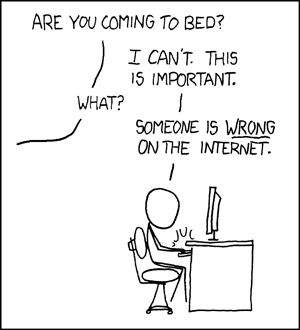
In the end, I guess it doesn't really matter.  "Art" is nebulous enough to warrant it's own debate as to its definition.  I know what I think, and without better, more exact definitions, I don't think I can be "wrong".

2010/04/15

Scheduling

I just went to the refrigerator in the break room to fill up my water bottle.  I rounded the corner, and there was my colleague Jack JUST starting to fill up his water bottle.  I have a standard 20oz Aquafina bottle, and he as a 1.5L (~50oz) bottle.

I immediately tell him that he should let me go first because I have the smaller bottle  (it should be noted that Jack and I are on very familiar terms, so I can say these things).  He looks at me, like, "go to hell."  So I wait until he's done, and then fill up my bottle, meanwhile getting into a discussion with a third coworker about how this reminds me of my operating systems class in college, and how to schedule computing tasks.  First-come, first-served?  Shortest job first?

Back at my desk, I do some scratch work.

Adam has a 20oz bottle.
Jack has a 50oz bottle.
Let's assume that the fridge serves 1oz/second for easy math.

So, it takes me 20 seconds to fill my bottle, and 50 seconds for Jack to fill his bottle.
If I go first, and then Jack, then I wait 20 seconds (and leave), and Jack waits 20+50=70 seconds.
If Jack goes first, then Jack waits 50 seconds (and leaves), and I wait 50+20=70 seconds.

So who should go first?  One answer depends on whether you're Jack or Adam.  :)

However, if Jack and I are a TEAM, whose interests are locked together (which, you know, I kind of like to think we are), then we need to look at the total times.

If I go first, the total time we BOTH wait is 70+20=90 seconds.
If Jack goes first, the total time we BOTH wait is 50+70=120 seconds.

He should have let me go first.  After I figure this out, I showed him my calculations.  He looked at me, like, "go to hell."  :)

This kind of scheduling isn't just esoteric computer stuff.  Imagine you're a sushi chef taking orders.  Do you fill the orders in the order they are received, independent of how long it takes?  Or do you sometimes fill the smaller orders out of turn to get them out of the way?  If so, then you obviously can't postpone the bigger order indefinitely, so what is the right balance?  In the long run, what is best for your business?

I actually started designing a board game around this exact concept, but never got anywhere with it.  But the potential is there.


2010/04/12

Cyberchondria

My name is Adam S., and I am a cyberchondriac.

From Wikipedia:
"Cyberchondria (or cyberchondriasis) refers to the unfounded escalation of concerns about common symptomology based on review of search results and literature online. Articles in popular media position cyberchondria anywhere from temporary neurotic excess to adjunct hypochondria. Cyberchondria is a growing concern among many healthcare practitioners as patients can now research any and all symptoms of a rare disease, illness or condition, and manifest a state of medical anxiety."

(I was originally going to write "hypochondriac" up there, but saw the link to "cyberchondriac" and thought that was more appropriate).

At some point in my adult life, I've become very aware of my body and its sensations.  I frequently feel my heart thudding in my chest (particularly if it skips or double-beats), and all sorts of run-of-the-mill aches and pains and spasms get amplified into significant issues.  It's not a pervasive problem that affects me all the time, but it really can cause some anxiety in short term bursts.

When I turned 35, I decided it would be a good idea to schedule a physical exam.  I had a laundry list of minor problems that I wanted to talk about (warts on my feet, expired migraine medication, etc).  It had been years since I'd seen a doctor, so I figured 35 was as good a time as any to get a status update.  If there were any problems, they could be discovered and treated, and if not, then at least I'd have some baseline results for comparison as I get older.

My physical went fine, but I had to come back a day later (after fasting overnight) to give blood and a urine sample.  I then scheduled a followup appointment to discuss the results of said tests.  At that followup appointment, my doctor went over my numbers from my tests.  Every value fell right in line with the normal tolerances.  My cholesterol numbers are spectacular, due to some awesome genetics.  There was one exception, though, circled on my chart.  I had red blood cells in my urine.  My doctor (who is kind of a strange guy with not the best bedside manner) wanted me to do another test.  So I headed to the lab and peed in another cup.

By the time I got back to work, I'm already starting to freak out.  Blood in my urine?  What does that mean?  Of course, I go to the same source that I used to answer all my other questions in life:  Google.

Google tells me that RBCs in the urine (microhematuria, I now know it to be called, or frank hematuria if you can actually see the blood) can by cased my many issues, some harmless, some life-threatening (my stomach lurches as I read this) and sometimes the cause is never discovered.  Over the course of the next hour, I wonder if I have kidney disease, kidney cancer, bladder cancer, prostate cancer.  If I'm lucky, maybe it's just kidney stones or early onset prostate enlargement.  I picture my organs getting x-rayed and ghostly white blobs showing up where they're not supposed to be.  I wonder if I'll have to find someone to donate a kidney.

I barely slept that night.  That was Thursday.

On Friday, I called in the afternoon to see if my results were in, and they said they'd call back when they got them. I never got a call back.  I got a login and password to their online system so that I could login and check my charts online, but there was a bit of a mixup and my information wasn't available.  It would be fixed on Monday.

Over the weekend, I was a bit better.  I could convince myself that maybe it wasn't such a big deal.  Or if it was a big deal, well, it was a bridge that would be crossed in due time.  There was nothing I could do about it.

I remember as a kid a TV commercial about a guy being scared to go to the doctor because he didn't want to hear bad news.  I remember my dad commenting about it being a stupid commercial (strong words from Papa S, which is why it sticks out in my memory).  If there is bad news, it's there whether you go to the doctor or not, and learning about it early is always better.  I resigned myself to just having to wait out the weekend, and steeled myself against whatever bad news was coming.  But I still checked my pee.  Did it look darker than usual?

This morning, after dropping off Allison and driving to work, I pictured what was going to happen today.  I'd get a call from my doctor's office (or worse, my doctor himself).  They'd say I needed to come in for more testing.  This would lead to urinary tract imaging, and who knows what from there.  At almost that exact moment, my cell phone rang.  It was my doctors office.

The nurse was just calling to inform me that my repeat urinalysis came back normal.

A chorus of angels burst out in song as a beam of heavenly light broke through the clouds and shone down through my car window.  An amazingly enough, the mysterious pangs of discomfort I'd been feeling in my lower abdomen immediately cleared up.  As anxious as I'd felt all weekend, I feel the opposite right now.

It's strange, because I'm typically not a stress-ball about much of anything.  I can definitely look back on this weekend and laugh at myself, and hopefully apply some lessons learned in the future.


2010/04/05

Easter

So the Easter Egg Hunt was actually a moderate success!

On Saturday, Diana took Allison over to her parents house, where her dad had made up a similar Easter Egg treasure hunt.  I wasn't there, but understand that he had a word in each egg.  So Allison would find an egg, and someone would tell her the word that would lead her to the next egg.  Sounds good in theory, but apparently didn't go to well in practice.  I set my expectations suitably low.

My egg hunt was slightly different.  I was using pictures of hiding places instead of words, and I put a jelly bean in each egg (let's face it, she's not in it for the intellectual pursuit).  There were ten total eggs hidden.  I don't think she ever really fully grasped the concept, but she would open an egg, gobble down the jelly bean, and with some prompting look at the picture.  I'd hold up the picture and say "go here" and she'd sprint off and find the next egg.  It took a little bit of prodding, but she found all the eggs, and finally a big basket packed with goodies (Lightning McQueen and Mater socks!) and was happy with that.

We later randomly hid some eggs for her to find, some empty and some with little toys inside.  She'd pick an empty one up, shake it and discover it was empty, and chuck it back down on the ground again, like "this is useless to me."  Awesome.  +1 to materialism!